Maryland Cannabis Policy Update: Regulatory Refinement and Market Structuring Continue
Maryland Cannabis Policy Update: Regulatory Refinement and Market Structuring Continue
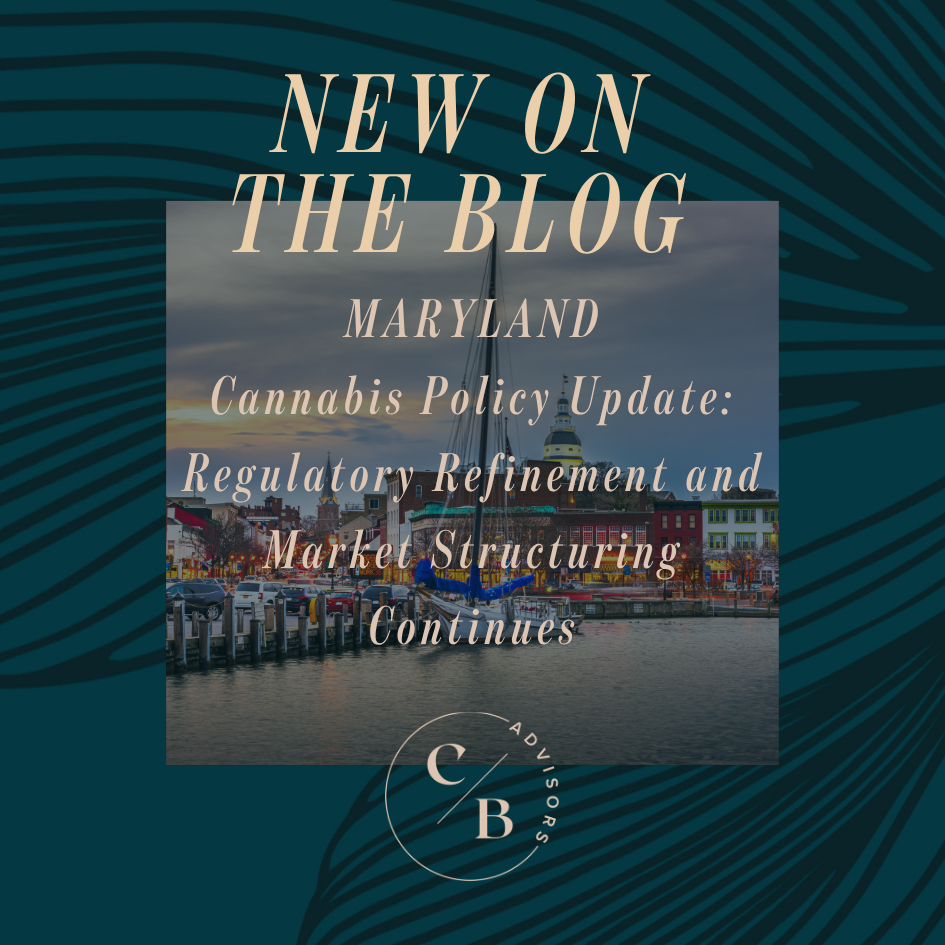
Maryland’s cannabis market continues to evolve following its transition to adult-use sales, with recent developments focused on refining regulatory structure, ownership rules, and operational standards. Over the past 30 days, legislative proposals, regulatory updates, and judicial clarification have provided additional definition around how the market will function long term. For investors and operators, Maryland is entering a post-launch stabilization phase, where clarity is increasing, but so are expectations.
For stakeholders, the focus is now on structure, compliance, and capital strategy.
Current Legal Status
Maryland operates a fully legal medical and adult-use cannabis program, with regulated sales to adults 21 and older through licensed dispensaries. The state allows:
- adult-use possession and purchase for individuals 21+
• regulated cultivation, processing, and retail through licensed operators
• limited home cultivation within defined thresholds
Maryland’s framework combines existing medical infrastructure with adult-use expansion, creating a hybrid model that continues to evolve through regulatory refinement.
Recent Legislative Activity: Ownership and Market Structure
One of the most notable developments in the past 30 days is the advancement of legislation focused on ownership structure and operational control, including House Bill 1519.
Key proposed updates include:
- clarification of what constitutes “control” in cannabis businesses, including exclusions for certain management services agreements (MSAs)
• allowance for MSA structures where compensation does not exceed defined revenue or profit thresholds
• reduction of ownership transfer lock-up periods from five years to three years
• expanded flexibility for passive investors and certain franchisor relationships
• continued regulatory oversight of management and operational agreements
Collectively, these changes signal a shift toward greater capital flexibility and more sophisticated operating structures, while maintaining regulatory visibility.
For investors, this introduces clearer pathways for structured partnerships, capital deployment, and long-term positioning within the market.
Recent Regulatory Updates: March 2026 Implementation
In early March 2026, Maryland implemented a series of regulatory amendments that directly impacted operations across the market.
Key updates include:
- authorization for dispensaries to operate walk-up service windows
• extension of conditional license activation timelines from 18 to 24 months
• reduction in agent registration fees
• expanded allowances for high-dose liquid products within the medical program
These updates reflect a continued effort to support operational viability, particularly for newer and social equity license holders, while refining how the market functions in practice.
Judicial Update: Enforcement Clarification
In Cutchember v. State (March 3, 2026), the Maryland Supreme Court clarified that the state’s prohibition on cannabis-related searches based solely on odor does not apply retroactively.
The court emphasized that the 2023 legalization framework created a new substantive right, which cannot be applied to enforcement actions that occurred prior to its effective date.
Market Regulation: Continued Oversight of THC Products
Maryland regulators continue to focus on controlling the broader THC marketplace, particularly around unregulated or hemp-derived products.
Recent enforcement trends include:
- restrictions on intoxicating hemp-derived products outside licensed dispensaries
• stricter THC thresholds for retail sale channels
• increased oversight of packaging, labeling, and product classification
These efforts align with a broader national trend of bringing previously unregulated products into licensed frameworks, reinforcing dispensaries as the primary compliant channel.
Market Context: From Launch to Stabilization
Maryland’s cannabis market has transitioned quickly from rollout to refinement.
The current environment is defined by:
- an operational adult-use market built on existing medical infrastructure
• ongoing regulatory adjustments to ownership, compliance, and enforcement
• a continued emphasis on controlled licensing and social equity implementation
• increasing clarity around operational expectations
This places Maryland in a category of markets that are no longer emerging, but not yet fully mature.
What This Means for Investors and Operators
Maryland remains an attractive market that is becoming more structured.
For investors and operators, key implications include:
- potential expansion of ownership and partnership structures if legislative updates pass
• increased importance of compliance as enforcement clarity improves
• continued consolidation opportunities as the market stabilizes
• tighter control over product channels, particularly outside licensed dispensaries
At this stage, success in Maryland will depend less on timing and more on alignment with evolving regulatory expectations and capital strategy.
What to Watch Next
As Maryland continues to refine its framework, several developments will be important indicators of market direction:
- progression and potential passage of ownership and control legislation
• additional regulatory guidance from state authorities
• enforcement trends related to product classification and retail channels
• future licensing rounds or adjustments tied to social equity goals
These signals will shape how accessible and how competitive the market becomes over time.
Near-Term Consideration: Tax Structure
Looking ahead, Maryland’s cannabis sales and use tax is scheduled to increase from 9% to 12% beginning July 1, 2026, under prior budget legislation.
While not a new development, the approaching implementation date is a relevant consideration for operators managing pricing strategy, margin projections, and overall market positioning.
The Bottom Line
Recent developments highlight a clear focus on ownership flexibility, enforcement clarity, and tighter product oversight. While the market remains active and established, its long-term trajectory will be shaped by how these adjustments are implemented.
For investors and operators, Maryland represents a structured and evolving market—where success will depend on strategy, compliance, and adaptability.
About Cannabis Business Advisors
For operators, investors, and entrepreneurs navigating cannabis policy and emerging markets, understanding how regulatory developments translate into operational strategy is critical.
Cannabis Business Advisors (CBA) tracks legislative developments, regulatory changes, and market dynamics across the United States to help industry leaders make informed decisions in a rapidly evolving industry. If you are evaluating opportunities in Maryland’s cannabis market or want to discuss how recent regulatory shifts could impact market entry and compliance strategy, contact us at 602-290-9424 for additional insights.
This article is part of CBA’s ongoing state policy intelligence series tracking regulatory developments across emerging cannabis markets.
The Cannabis Business Advisors have more than thirty years of combined industry experience, spanning across the U.S. and around the globe. C.B. Advisors offers a comprehensive suite of services, including application and licensing preparation, operational analysis, merger and acquisition support, policy and procedures, exit strategy guidance, and business development planning. Stay up to date on the latest cannabis news with The CB Advisors!
Contact Info@thecannabisbusinessadvisors.com for more information on how to apply for a cannabis business license.